



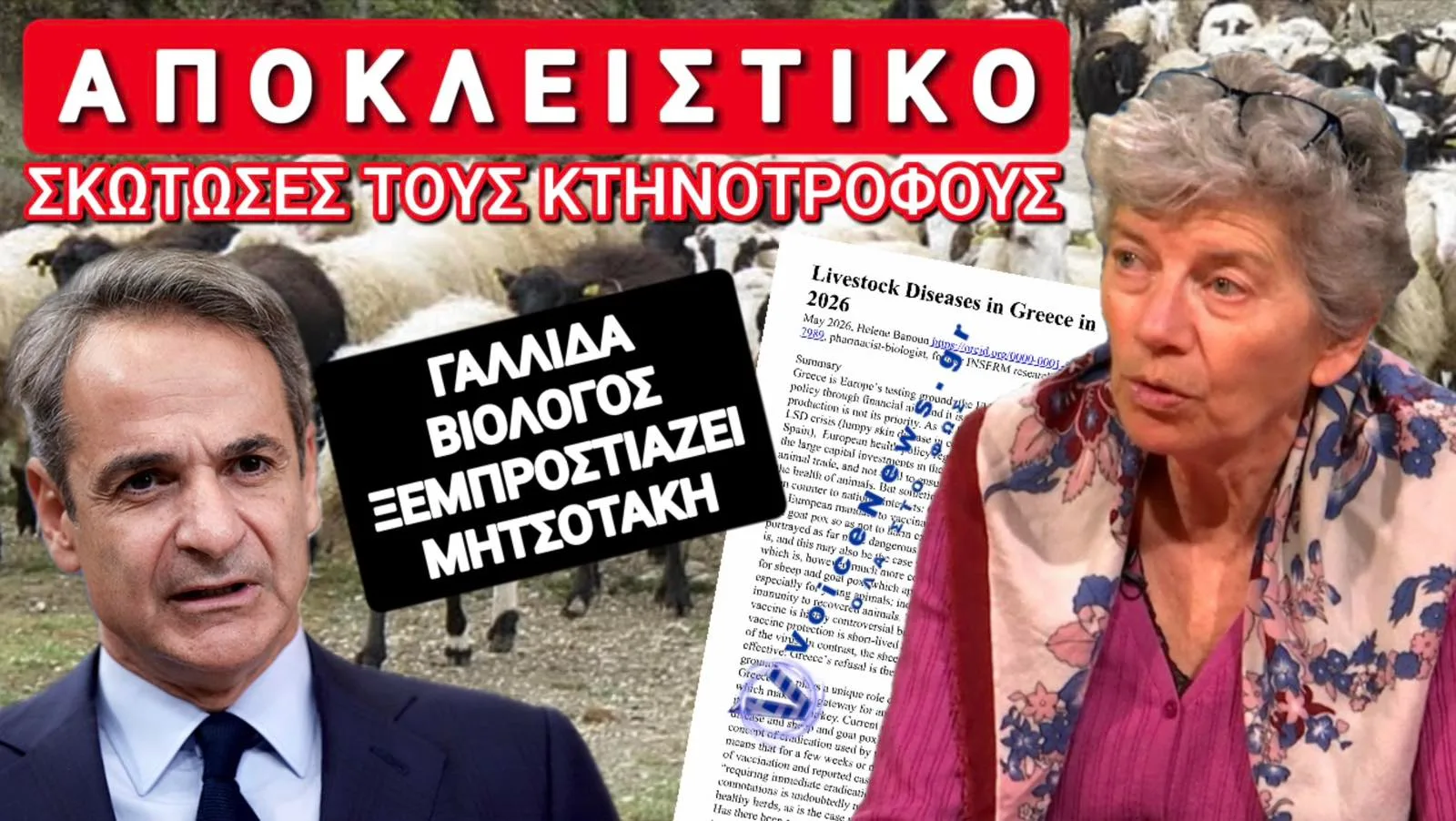
Σε μια αποκαλυπτική ανάλυση που θα έπρεπε να προκαλέσει τριγμούς στην ηγεσία του Υπουργείου Αγροτικής Ανάπτυξης, η κορυφαία Γαλλίδα φαρμακοποιός-βιολόγος και πρώην ερευνήτρια του INSERM, Helene Banoun, εκθέτει την αποτυχία της ελληνικής διαχείρισης απέναντι στην ευλογιά των προβάτων και τον αφθώδη πυρετό.
Η έγκριτη επιστήμονας, με επιστολή της στο voicenews, χαρακτηρίζει την Ελλάδα ως «πεδίο πειραμάτων» της Ε.Ε., όπου η αγροτική παραγωγή θυσιάζεται στον βωμό των οικονομικών συμφερόντων και των εξαγωγών.
Η «Σφαγή» των Κοπαδιών αντί του Εμβολιασμού
Η Banoun εξαπολύει δριμύ κατηγορώ για την τακτική της μαζικής θανάτωσης υγιών ζώων. Σύμφωνα με τα στοιχεία της, μέχρι τον Απρίλιο του 2026, έχουν θανατωθεί στην Ελλάδα 486.666 αιγοπρόβατα (το 5-10% του εθνικού κεφαλαίου) για μόλις 2.152 επιβεβαιωμένα κρούσματα ευλογιάς.
«Η θανάτωση 500.000 ζώων είναι μια δυσανάλογη θυσία. Ακόμα και με 100% θνησιμότητα, οι απώλειες θα ήταν ελάχιστες μπροστά στην καταστροφή που προκάλεσε η κρατική εντολή», τονίζει η βιολόγος.
Το «Ταμπού» της Φέτας και η Άρνηση Εμβολιασμού
Η Γαλλίδα επιστήμονας αποκαλύπτει πως η κυβέρνηση αρνείται πεισματικά τον εμβολιασμό, παρά τις συστάσεις της EFSA και της Ε.Ε., για έναν και μόνο λόγο: να μη χαθεί το καθεστώς «ελεύθερης νόσου» που επιτρέπει τις εξαγωγές φέτας ύψους 1 δισ. ευρώ. Ενώ ο εμβολιασμός για την ευλογιά είναι εξαιρετικά αποτελεσματικός (80-100%), η ελληνική πλευρά προτιμά να «εξαφανίζει» ολόκληρα κοπάδια, οδηγώντας τους κτηνοτρόφους στην απόγνωση.
Η Banoun σημειώνει πως η πολιτική αυτή εξυπηρετεί τους μεγάλους εξαγωγείς και το κεφάλαιο της αγροδιατροφής, αδιαφορώντας για την επιβίωση των μικρών παραγωγών και των μοναδικών ελληνικών φυλών.
Διάτρητη Βιοασφάλεια και Σκάνδαλα
Όσα λέει η Γαλλίδα επιστήμονας «καίνε» το Υπουργείο και για την αποτυχία στην τήρηση των μέτρων:
• Συστημικές αδυναμίες: Έλλειψη κτηνιάτρων και πλημμελείς έλεγχοι στα σύνορα με την Τουρκία.
• Το σκάνδαλο ΟΠΕΚΕΠΕ: Η Banoun συνδέει την κρίση με την παύση των επιδοτήσεων λόγω απάτης, που άφησε τους πραγματικούς κτηνοτρόφους απροστάτευτους.
• Παράνομος Εμβολιασμός: Η απόγνωση οδηγεί κτηνοτρόφους στην παράνομη εισαγωγή εμβολίων από την Τουρκία.
Η Helene Banoun θέτει το αμείλικτο ερώτημα: Υπήρξε ποτέ δημοκρατικός διάλογος; Η διαχείριση της κρίσης το 2026 δείχνει ότι το κόστος της θανάτωσης εκατοντάδων χιλιάδων ζώων θεωρήθηκε «προτιμότερο» από την ολιγόμηνη παύση εξαγωγών φέτας. Η επιστήμονας καλεί την Ελληνική Βουλή σε άμεση διακοπή της μαζικής σφαγής και εφαρμογή εμβολιασμού, προειδοποιώντας ότι η τρέχουσα πολιτική απειλεί την ίδια την ύπαρξη της ελληνικής κτηνοτροφίας.
Διαβάστε την επιστολή της Hellen Banoun ΕΔΩ:
It is important to closely monitor developments in Greece, which serves as a sort of testing ground for Europe. This country of 10.8 million people receives the highest level of European aid relative to its population and GDP (aid accounts for 19.6% of Greek GDP, compared to an average of about 5.2% for the EU as a whole), This overrepresentation is explained by its low GDP per capita and high unemployment, which are partly the consequences of the 2008 economic crisis.
The over-allocation of grants and non-repayable aid is primarily directed toward the “energy transition”: Greece has significantly expanded “renewable” energy (solar and especially wind) and produces more electricity than it consumes, given the limited development of its industrial sector. The other sector for which the EU funds Greece is the “digital transition” (digitization of administration and education, and digital infrastructure). Agricultural subsidies are broadly comparable in total amount to those of other countries of similar size, but lower per hectare than in many Western European countries because most farms are very small. These subsidies represent, as elsewhere in the EU, a significant portion of agricultural income. But farmers have been penalized by massive fraud that diverted subsidies to people sometimes with no connection to agriculture, who declared false pasture lands or exaggerated their number of animals. This OPEKEPE scandal led to the resignation of several ministers in April 2026. Subsidies were frozen by the EU, and genuine farmers did not receive their aid .
It was against this backdrop that two outbreaks of animal diseases classified as Category A by the EU—meaning they require immediate eradication—were reported.
An outbreak of foot-and-mouth disease (FMD) on the Greek island of Lesbos in 2026.
The disease and history of recent outbreaks
FMD is classified by the EU as a Category A animal disease and is therefore subject to immediate eradication. It is officially considered a very serious disease. Above all, it is highly contagious; the virus responsible is very resistant—it is an RNA virus that mutates and recombines frequently. As a result, it easily evades both natural and vaccine-induced immunity. According to ANSES, convalescent, recovered, or vaccinated animals can carry and shed the virus for several months, making them particularly dangerous to disease-free animal populations, even though the frequency of this phenomenon is difficult to quantify .
The virus spreads easily across borders, and Europe is regularly at risk because Asia—and Turkey in particular—are endemic areas.
It is difficult to gauge the true severity of the disease. According to a report on the epidemic that has been raging in Lebanon since November 2025, 53 outbreaks have been reported involving 8,391 animals suspected of being infected, 2,934 confirmed cases including 7,391 suspected cattle, 2,734 confirmed cases, and 51 deaths. This represents a mortality rate of 0.69%, a case fatality rate of 1.9%, and a morbidity rate of 37% among cattle. Lebanese farmers estimate that 60 to 70% of herds have been affected by this epidemic, resulting in a loss of milk production of up to half of usual volumes. Mortality and case fatality rates are therefore certainly lower than the figures from official data, but the danger of this disease is primarily economic in nature due to the decline in milk production and the loss of income for farmers . The disease is generally detected through a drop in milk production, which appears to be the only symptom in recent cases in Cyprus and Turkey .
The response of authorities to FMD varies by country and time period : in the Turkish part of Cyprus, in 2025, animal movements were banned, strict disinfection measures were imposed, and infected herds were quarantined and mass vaccination was carried out. No culling was reported.
In 2007, in the same region, total culling without vaccination was implemented and contained the epidemic within 6 months. In Lebanon, mass vaccination was implemented along with controls on animal movements. In the European part of Cyprus, 104 outbreaks have been detected since February 19, 2026, according to the April 28, 2026, bulletin from the ESA , and the response was mass vaccination.
In South Africa, a large-scale livestock vaccination campaign is underway to eradicate foot-and-mouth disease. The epidemic, which has been intensifying since late 2025, threatens the supply and exports of dairy products and beef. More than 297,000 animals have been affected in KwaZulu-Natal—the epicenter of the disease—and more than 120,000 animals have been culled. Industry professionals fear job losses and millions of dollars in lost revenue, since countries such as China and Zambia have banned imports of South African meat.
Canada has a vaccine stockpile but does not vaccinate in order to maintain its disease- and vaccination-free status. If an outbreak occurs, a total cull (of infected and exposed animals) is planned, along with emergency vaccination.
France maintains a vaccine bank (containing six strains) in collaboration with Boehringer Ingelheim, which manages the bank at.
The EU discontinued vaccination in 1991 because the disease was officially eradicated. Routine vaccination is prohibited, but emergency vaccination may be implemented in the event of a crisis.
The concept of eradication is relative, as outbreaks have occurred regularly since then: in Italy (1993), in Greece (in 2000, involving animals from Turkey), and in the United Kingdom in 2001. In Germany, an outbreak occurred in January 2025, but Brussels does not authorize vaccination. Germany lost its disease-free status on January 9, 2025, and regained it on April 14, 2025. More recently, 5 outbreaks were reported in cattle in Hungary and 6 in Slovakia (2025). According to the ESA (Epizootic Surveillance in Animal Health, March 2026 report ), the outbreak in Central Europe is under control. More than one million doses of vaccine from the European vaccine bank have been supplied to Cypriot authorities. Turkey is also vaccinating, with an estimated coverage rate of 90% by early spring.
The EU’s primary goal is to maintain its disease- and vaccination-free status in order to continue exporting. It maintains a vaccine bank of 30 million doses to address an epizootic outbreak that could spiral out of control : preventive ring vaccination around outbreak sites would then be implemented. The problem is that the virus can continue to circulate silently among vaccinated animals. Furthermore, there are several strains of the foot-and-mouth disease virus (7 strains and 80 subtypes), and vaccines are effective only against the targeted strain; countries that practice preventive vaccination regularly see new outbreaks caused by strains not targeted by the vaccine [] .
According to the World Organisation for Animal Health ( , OIE), “It is important to use inactivated virus vaccines, as these are unable to replicate in vaccinated animals. The use of live virus vaccines is not acceptable due to the risk of reversion to virulence. Vaccination can play a role in an effective foot-and-mouth disease control strategy, but the decision on whether or not to use vaccination rests with national authorities.”
Foot-and-mouth disease outbreak in Greece on the island of Lesbos (opposite Turkey) in 2026
According to the ESA (bulletin of April 28, 2026), 54 outbreaks have been detected on the island since March 15, 2026; the disease is endemic in Turkey. On Lesbos, it involves mixed cattle/sheep/goat herds. According to the ESA (April 28, 2026 bulletin), the disease causes mortality only in young animals; clinical cases have been reported but no severe disease. The ESA notes a significant proportion of animals that are seropositive in serological testing, while virological results are negative. This means that FMD has spread subclinically among small ruminants. The virus can therefore circulate without causing disease; the danger of this virus thus lies in its resistance and contagiousness, not in the severity of the disease it causes. Yet this disease is presented as very serious by the authorities. However, according to the WOHA’s official bulletin , no animals died, and the morbidity rate in the first outbreak was 3% according to the GTV . Nevertheless, 8,000 to 10,000 animals (mainly sheep and goats) were culled from the herds of the island’s 3,000 farming families. The EU refuses to implement vaccination to protect the disease-free status for the benefit of major feta exporters, and the Greek government agrees. However, the EU is making its vaccine bank available to Greece in case of a change of heart . Farmers are demanding vaccination and are sometimes blocking the port of Mytilene to obtain it . We have seen that vaccination is a poor solution since it provides only 6 months of protection against the circulating strain, which is capable of mutating rapidly and evading the vaccine; furthermore, it allows the virus to circulate undetected. Surveillance of farmers is being stepped up : 14 military veterinarians have been sent to the island, and the sale of cheese is subject to strict conditions ; the government has announced “full financial support” for farmers , but it is well known that the promised subsidies are often not paid out . Greek scientists from the University of Athens are calling for a halt to the mass culling of sheep (which represent a unique breed adapted to the ecosystem and produce cheeses including feta) and for emergency vaccination. According to them, based on scientific studies, vaccination with DIVA (differentiation of infected from vaccinated animals) vaccines is less expensive than culling herds and is more effective in controlling the disease.
We have seen that vaccination is not the ideal solution either. The economic losses actually caused by FMD should be independently assessed : are all these biosecurity measures proportionate to these losses ?
Sheep pox and goat pox
European authorities and agricultural unions have issued alerts regarding sheep pox and goat pox this spring of 2026 and the risk of their introduction into France. An epidemic has been raging in Greece, Bulgaria, and Romania since August 2024, with a resurgence in 2025–2026. These diseases are caused by viruses of the genus Capripoxvirus, from the same Poxviridae family as that of LSD; they are closely related and highly contagious among goats and sheep; the disease spreads over long distances through the transport of animals and contaminated materials (the viruses are highly resistant).
The caprine and ovine viruses are genetically very closely related (approximately 96–97% nucleotide identity) to each other and to the LSD virus, and are antigenically similar. This means that antibodies against these viruses cannot be distinguished by conventional serological tests; only molecular methods (specific PCR) can differentiate the viral genomes . They cause characteristic skin lesions (nodules, papules, scabs) and systemic signs such as fever. The severity of the disease depends on the infected animal breed and the viral strain, and is influenced by malnutrition, fatigue, and parasitic infestation: as with LSD, the severity of the disease in a naive population cannot therefore be predicted. Lambs are particularly susceptible and often die from the disease : this is the disease’s greatest economic impact, along with reduced milk production.
The viruses are not transmissible to humans. Unlike LSD, transmission occurs through direct contact. Animals that survive the disease are immune for life. Specific attenuated vaccines against these viruses and those against LSD provide cross-immunity (heterologous protection) . Sheep and goat pox is endemic in Africa, the Middle East, Turkey, Russia, Central Asia, India, and China. Outbreaks have been observed in Europe (in Spain in 2022–2023, and in Greece and Bulgaria since 2024). The disease was likely introduced through transhumance and the illegal movement of animals.
Morbidity and mortality associated with the disease
According to the 2021 EFSA (European Food Safety Authority) report, morbidity and mortality are poorly understood in regions where the disease is not endemic, such as Europe. The level of virulence depends on the strain and the infected breed; European sheep and goats are more susceptible than indigenous African and Asian breeds. The EFSA does not rule out the possibility of subclinical infection, and experts estimate that 100% of susceptible animals develop the disease following experimental inoculation. The disease is endemic in Africa, the Middle East, Turkey, and Asia (India and China). The EFSA recommends controlling the disease in non-endemic areas through culling, movement restrictions, and disinfection .
According to an Ethiopian study conducted in an endemic area , the morbidity, mortality, and case-fatality rates were 50.8%, 2.9%, and 5.8% in goats, and 52.3%, 1.2%, and 2.2% in sheep. Deaths were found almost exclusively among young animals, particularly newborns. In Pakistan, a study found a morbidity rate among goats of 16% (males) and 6% (females); a mortality rate of 3% and 2%, and a case fatality rate of 20% and 39% for males and females, respectively. In sheep in India, morbidity ranged from 47% to 75% and mortality from 3% to 37% . Mortality therefore varies depending on the breed and the countries where the disease is endemic.
European regulations require the culling of all affected herds and biosecurity measures similar to those applied for bovine LSD, with vaccination serving as a supplementary measure : the decision rests with member states in consultation with the EU. Greece, Bulgaria, and Romania have implemented total culling and biosecurity measures but have not launched a vaccination campaign. In contrast, Turkey has not culled but has vaccinated .
In Greece, for the period from August 2024 to April 19, 2026, a total of 2,152 cases of sheep and goat pox were confirmed, and the number of affected farms stands at 2,660. 486,666 sheep and goats were culled, representing 5 to 10% of the national livestock population. Between April 6 and 19, 2026, a total of five new cases were reported. The movement of goats and sheep, as well as grazing, is prohibited until June 30, 2026, that is, during the period of abundant forage. The culling of 5 to 10% of the national livestock population must be weighed against the mortality rates (between 1 and 37%) and case-fatality rates (2 to 39%) observed in endemic countries: is this justified? There were 2,152 cases in Greece; even with a 100% case fatality rate, there would have been 2,152 deaths, compared to the 486,666 sheep culled. One might argue that these culls prevented the deaths of many more animals: experts are therefore anticipating a very high mortality rate without any precise data, since no one knows the actual mortality (death rate among the total population) and case fatality (death rate among infected animals) rates for animals in Greece.
Vaccines
The UE recommends the emergency use of attenuated vaccines and makes doses available through the vaccine bank. The EU maintains a strategic vaccine stockpile of approximately 500,000 doses intended for emergency deployment: as with the LSD, these are live attenuated vaccines produced outside the EU and therefore not approved for routine use within the EU. These vaccines offer good protection (80–100% against mortality and a significant reduction in viral shedding), but they generally do not allow for easy distinction between vaccinated and infected animals (no reliable DIVA test), which poses a problem for the country’s trade status. The main vaccine in stock is based on the RM65 strain (or Yugoslavian RM65 strain), sometimes combined with other closely related strains such as the Romanian strain.
Efficacy and safety of vaccines : Live attenuated vaccines remain the most effective (80–100%), with a significant reduction in viral shedding. They are particularly effective against mortality, but may cause local or systemic reactions in certain susceptible breeds .
According to the EFSA, nationwide vaccination would allow the disease to be controlled within a year, whereas regional vaccination alone risks allowing the virus to escape unless strict measures to control animal movements are enforced (these measures are not enforced strictly enough in Greece) .
Greek Government’s Resistance to Vaccination
The Greek government (under Prime Minister Kyriakos Mitsotakis) is refusing vaccination : it fears that vaccination will mask actual infections because biosecurity measures are not being properly followed on the ground. Greece refuses to vaccinate for fear of losing its disease-free status, which would lead to restrictions on exports of animal products (meat, milk, and cheese). Feta, a pillar of the Greek agricultural economy, is particularly at risk (€1 billion in exports ). The United Kingdom has already banned the import of live animals and animal products from Greece . The EFSA recommends vaccination . Vaccination is being called for by many Greek farmers , and some are even resorting to illegally imported vaccines (notably from Turkey [UK report]). The EU has sent several letters to Greece since May 2025 calling for strict enforcement of biosecurity measures (particularly regarding animal movements) and recommending vaccination. (“Commissioner Várhelyi wrote that the approach Greece had followed for more than a year was failing, citing systemic weaknesses in disease control—from shortages of official veterinarians and gaps in biosecurity to delayed detection, possible underreporting of suspected cases, and the continued, rapid spread of the virus into new areas.”). The Greek government claims, however, that Greece is following all EU recommendations, which is clearly false . Since mid-October 2025, 88 people have been arrested for allegedly violating bans on animal movement and grazing .
Has there been a democratic debate between farmers, their unions, and the government regarding this vaccination? Has the cost of this culling been weighed against that of vaccination? Vaccinating the livestock would result in a ban on feta exports for a few months, but is that more costly than culling 500,000 sheep?